 Livestock shipping RESUMED. Please bear with us while we catch up with the backlog of orders

Livestock shipping RESUMED. Please bear with us while we catch up with the backlog of orders
(Excludes pre-order items & Bank Holidays)
7-day refund window for health issues.
Shop equipment without breaking the bank.
Ships within 3 days! Order before 2pm, Monday-Friday. (Excludes pre-order items. Excludes Bank Holiday)
7 Day Live Guarantee for your pet covering 7 days after shipping for peace of mind.
Price Matched Products. Shop equipment without breaking the bank.
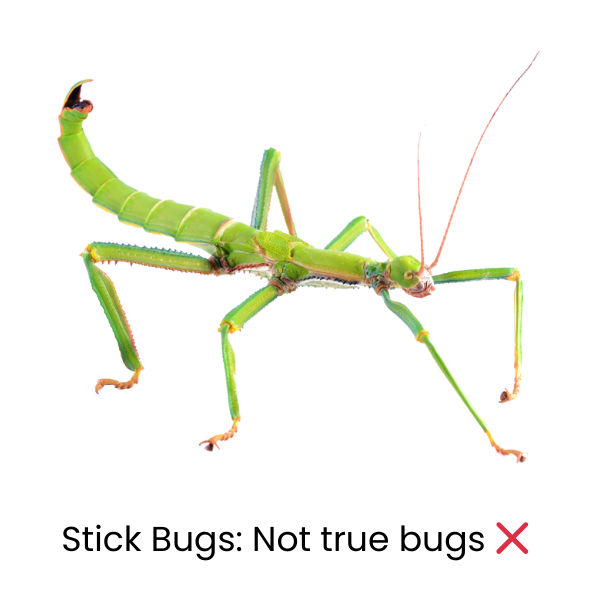
The word “bug” is often used loosely to describe insects, arachnids, millipedes, and other small crawling creatures. But did you know that, scientifically speaking, only a very specific group of insects are considered true bugs? They’re part of a club called Hemiptera, known for their straw-like mouthparts made for poking and sipping.
By this definition, even stick insects and mantis aren’t actually bugs, but Assasin bugs are!


What unites all of these creatures that we casually call “bugs”? If we include insects like mantids, arachnids like scorpions, and myriapods like millipedes under this umbrella, the common denominator is that they are all Arthropods.
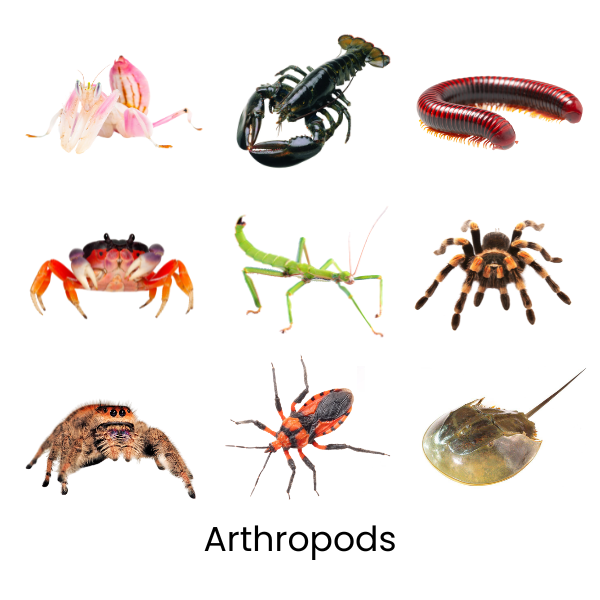
So what is an arthropod? To simplify it, Arthropods are creatures with a hard shell on the outside (exoskeleton), a body made of segments, and legs with joints. Millipedes, mantids, and scorpions are arthropods, but so are crustaceans like lobsters and crabs.
If you’ve ever heard a shrimp be compared to a ‘water bug’, this is the defining connection between insects and crustaceans. Crabs, lobsters, mantids, tarantulas – even barnacles are all closely related, stemming from one common ancestor – the ancestor of all members of the phylum Arthropoda.
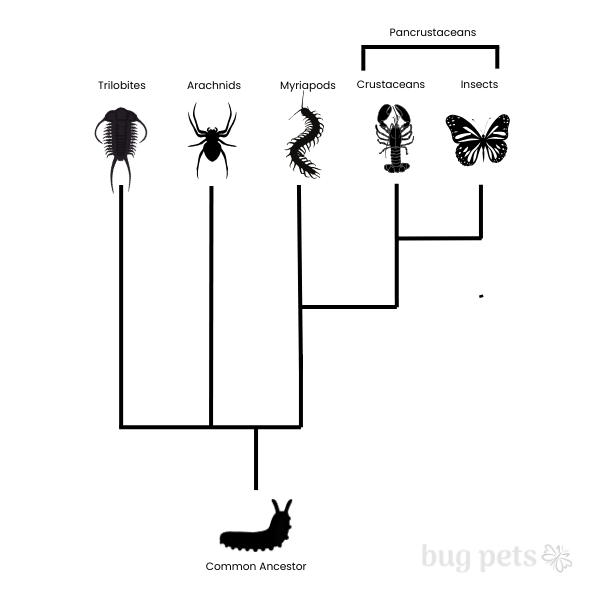
In this article, we’ll track down this common ancestor, and explain how it split into the many types of creepy crawlies known today.
To trace the origins of arthropods, we must go back over 540 million years, to a world vastly different from today. Life on land was virtually nonexistent, and the oceans lacked vertebrates, dominated instead by bizarre invertebrates.
By 541 million years ago, the Cambrian period had begun, and with it came one of the most dramatic bursts of evolution in Earth’s history – the Cambrian Explosion.
New types of animals started to appear at an incredible rate, including the world’s first powerful apex predators! Predation had likely never been a key issue until this point. But, like two nations preparing for war, an evolutionary arms race began, pushing the development of complex animals at a rapid rate.
At this ancient time in Earth’s history, the earliest common ancestor of arthropods likely resembled a lobopodian—a soft-bodied, worm-like creature with short, unjointed legs.


Lobopodians were likely the ancient ancestors of both arthropods—such as insects, arachnids, and crustaceans—and velvet worms, their distant cousins. Over time, these strange, worm-like creatures split into two evolutionary paths: one leading to today’s arthropods, the other to velvet worms.
Science suggests that around 540 million years ago, the common ancestor that we’re looking for probably resembled a small, soft-bodied marine worm.
To survive being eaten, many creatures had to evolve rapidly, or perish. It’s around this time in Earth’s evolutionary history that we begin to see the development of strong and sturdy armoured exoskeletons and spiky exteriors in animals for the very first time, which would keep them safe from predation.
Arthropods developed hard exoskeletons, jointed limbs, and advanced sensory organs like compound eyes, all traits that would be so useful, that they would stick around for the next 500 million years.
At this point in evolution, the ancestor of modern bugs had changed from a soft, worm-like creature into something flatter, tougher, and more segmented. It wasn’t fully an arthropod yet, but it was getting close. One of the best examples of this in-between stage is a little creature called Fuxianhuia.

A fossil and reconstructions of Fuxianhuia.
Fuxianhuia was a small stem-arthropod, about 4 cm long. It’s considered a strong candidate for the direct ancestor of arthropods—or at least a very close evolutionary cousin.
Around 520 million years ago, the common ancestor of insects, spiders, and crabs may have looked something like this!
After early stem-arthropods like Fuxianhuia, arthropods continued to evolve and diversify. Their bodies became tougher, their limbs more specialized, and their segments more defined. New forms appeared, each experimenting with different ways of living—some swimming, some crawling, some scuttling across the seafloor.
But, by 467 million years ago, we’ve reached a landmark point in our story. While not direct descendents of living insects, arachnids, or myriapods, sea scorpions are an important piece of the puzzle.


Sea scorpions, known scientifically as Eurypterids, are not true scorpions at all, although they were much, much bigger than them. Jaekelopterus was a predatory sea scorpion measuring up to 3 metres in length – the size of a crocodile, a titan compared to modern scorpions.
The most interesting point about the Eurypterids, however, is that many boasted a primitive version of a lung, called a book lung. This suggests that sea-scorpions, while not truly land-dwelling, were able to make short trips onto land. They may have scuttled onto shorelines, perhaps to escape predators, hunt stranded prey, or even lay eggs.
But, while some ventured onto land, they never fully adapted to life outside the water. They would soon be outcompeted, it would take their distant relatives to make the next big step, leaving the ocean behind for good.
It’s tempting to think that all land arthropods—like insects, arachnids, and millipedes—descended from a single land-dwelling ancestor. But in reality, each group made its own separate journey from the water to the land. The first to do so were the myriapods.
Myriapods, the group that includes centipedes and millipedes, are believed to have descended from Euthycarcinoids—small, segmented arthropods that lived in brackish water. But how exactly did they transition from water to land?

This is one example of what a myriapod ancestor may have looked like.
This euthycarcinoid likely lived in shallow, muddy waters, with a segmented, armored body and multiple legs for scuttling along lakebeds. It probably fed on decaying plant matter and may have briefly ventured onto damp land during low tides.
It’s likely that these millipede-centipede ancestors absorbed oxygen through their skeletons, much like modern crustaceans. However, to survive fully on land, myriapod ancestors needed a respiratory system that could handle air. So, they developed spiracles—tiny openings along their body segments that connected to an internal air tubes.
Instead of relying on dissolved oxygen in water, they could now pull in air directly, delivering oxygen straight to their tissues. Early myriapods could now move further away from water sources, eventually making them, ancient millipedes, the first true land-dwelling animals.
While myriapods were the first arthropods to fully adapt to life on land, arachnids took a different approach—one that made them the first true land predators.
Their ancestors were likely sea scorpion-like creatures, scuttling through brackish waters and breathing with gills. These eurypterid-like animals already had features like jointed limbs and pincers—traits that gave early arachnids a head start as land predators. But unlike their aquatic relatives, some of these early arachnids found ways to survive permanently on land.

This is one idea of what the ancestor of arachnids may have looked like. It resembles a more streamlined version of a horseshoe crab—and that’s no coincidence.
Horseshoe crabs are actually much more closely related to spiders and tarantulas than crabs and lobsters!
They belong to the same broader group as arachnids: the chelicerates, a lineage of arthropods built for grasping, slicing, and ambushing prey.
And it was from this lineage that the first land arachnids emerged. Around 420 million years ago, early scorpions—surprisingly similar to the ones we know today—appeared on land. These ancient predators hunted small prey like early myriapods and could even lay eggs outside of water.
With their tough exoskeletons and newly adapted lungs, they became the first arachnids to thrive in dry environments, setting the stage for all future land predators.
At this point in evolution, arthropods were branching into their major groups—myriapods, arachnids, and insects—each taking a different path onto land. While myriapods evolved from euthycarcinoid-like ancestors and arachnids from eurypterid-like hunters, insects had a surprising origin—they came from crustaceans.
Their ancestors of both crustaceans and insects were likely small, shrimp-like arthropods living in freshwater.


This is a rough idea of what the ancestor of both crustaceans and insects may have looked like—a small, shrimp-like arthropod that lived in freshwater.
From a creature like this, two major lineages would emerge: one would stay in the water and diversify into crabs, shrimp, and barnacles. The other would take its first steps onto land—and eventually become insects.
This tiny relative of both crustaceans and insects probably crawled along the bottoms of ancient lakes and streams, using gills to breathe and feeding on algae, detritus, or even each other. Over time, some of these animals began to spend more time at the water’s edge—perhaps hiding from predators or chasing food into damp environments.
With time, this led to the move onto land. Like myriapods, early insects developed spiracles to breathe air, allowing them to survive away from water. These tiny pioneers were the earliest hexapods—six-legged creatures that would eventually give rise to the insects we see today.
At first, these early insect relatives were wingless and likely spent most of their time close to the ground, feeding on decaying plant material, fungi, and microorganisms. But evolution wasn’t finished with them yet—over time, they gave rise to the first true insects. And eventually, insects would take to the skies.
Once insects took flight, there was no turning back. Wings gave them access to new food sources, helped them escape predators, and allowed them to spread rapidly across land.
By the time dinosaurs ruled the Earth, arthropods had already conquered land, air, and water, branching into countless forms and filling nearly every ecological niche.
As the world changed, arthropods evolved to meet new challenges. Insects, the most diverse and numerous arthropods, made one of evolution’s greatest leaps: they developed wings. By the Carboniferous Period, around 300 million years ago, they had taken to the skies, becoming the first creatures in Earth’s history to fly. With this new ability, they could travel farther, escape predators, and reach new environments.
While insects mastered the skies and land, arachnids refined the art of hunting. The earliest land scorpions, once tied to damp environments, became more efficient predators as their bodies adapted to life on dry land. Some arachnids evolved venomous stingers, others developed the ability to sense vibrations and spin webs—turning them into brilliant ambush hunters.
Myriapods, though less specialized than insects or arachnids, found success as both predators and decomposers. During the Carboniferous, some millipedes reached over six feet in length, feeding on rotting plant matter in the lush, humid forests of the time. Centipedes, on the other hand, adapted to become ferocious predators.
While their land-dwelling cousins thrived, crustaceans continued to dominate the water. They evolved into a vast selection of forms, from tiny copepods that support entire food chains to giant lobsters and king crabs that roam the seafloor. Some crustaceans, like isopods, even made the leap to land!
No matter where on earth they seemed to find themselves, arthropods found ways to survive and thrive.
Today, arthropods outnumber all other animal groups. Insects alone make up around 80% of all known species.
From the tiniest ladybird to the largest spider crab, their success is unmatched—and their story isn’t over. New species are still being discovered, and their ability to adapt all but guarantees they will outlive us, just as they’ve outlasted mass extinctions, and every dominant species before us.
Whether crawling, scuttling, creeping, or flying—arthropods are everywhere. The age of arthropods never ended. We are living in it!
References, info sources & further reading: evolution.berkeley.edu, shapeoflife.org, postasuchus.co.uk
Newsletter sign up
Sign up to be notified on new offers, species, & products in-stock.


All live pets purchased from us are guaranteed to be of great health. Any issues in 7 days? Let us know.